WHY E-QPASS
One Assessment.
Clearer Answers. Earlier.
The tools most commonly used in behavioral health today were designed for a different purpose — screening populations for pharmaceutical trials, not guiding individualized clinical care. They've become standard not because they're precise, but because they're familiar.
Familiarity is not
the same as precision.
PRECISION OVER HABIT
PHQ-9, GAD-7, and similar tools are widely used because they are familiar. Stacking multiple screeners fragments understanding and delays clarity. e-QPASS replaces that stack with a single, comprehensive assessment built for the realities of modern behavioral health care.
PHQ-9 / GAD-7 Approach

PHQ-9 / GAD-7 Approach
Broad, multidimensional symptom profile
Single assessment replaces multiple tools
Earlier clarity, starting at intake
Earlier, more nuanced risk identification
Maladaptive coping identified & contextualized
Designed for progression tracking over time
Narrow, condition-specific scope
Multiple screeners often needed
Clarity often comes later in care
Maladaptive coping not assessed
Limited suicide & violence risk detection
Limited measurement sensitivity over time

FULL COMPARISON
Every dimension, side by side.
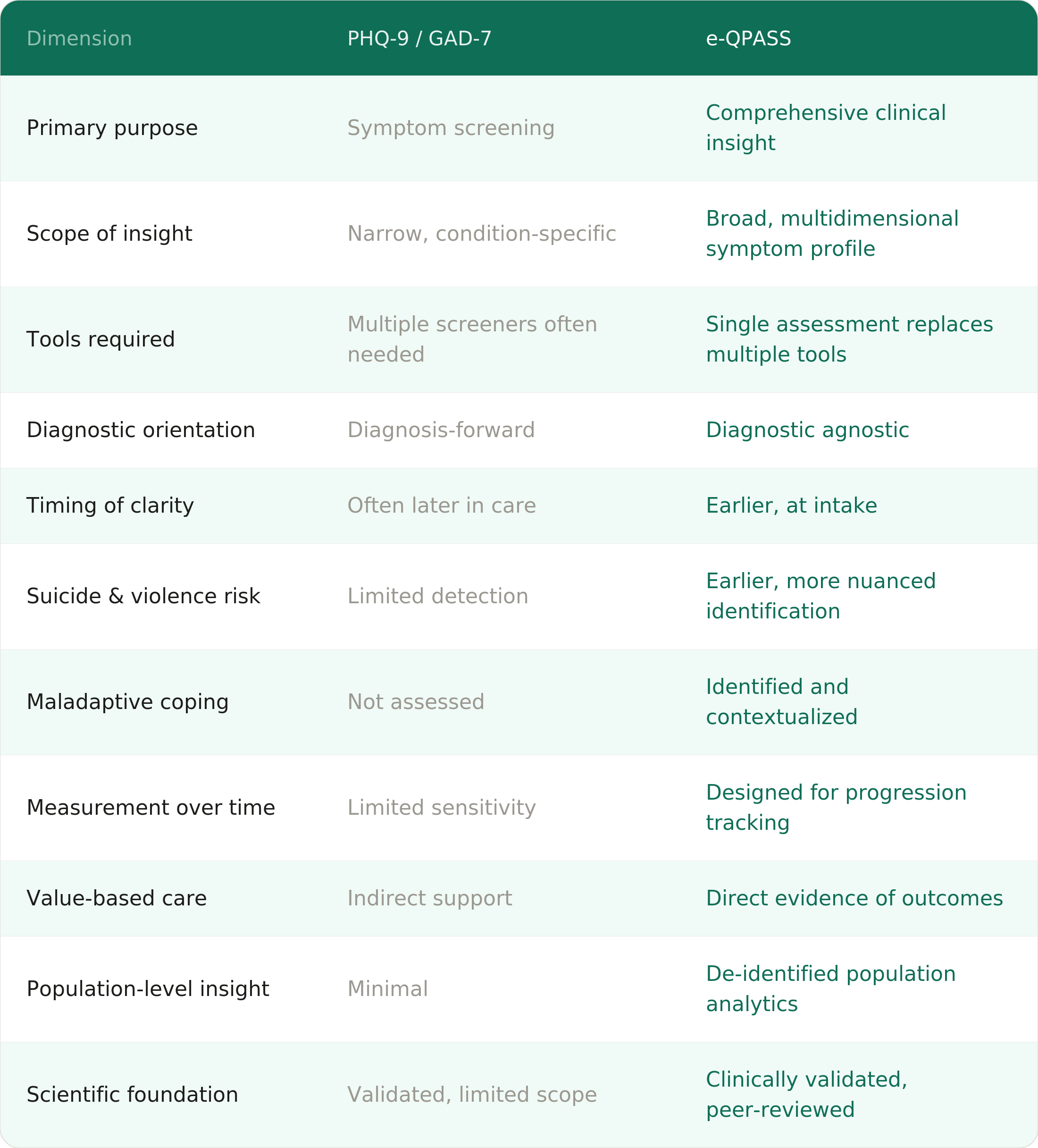
The difference isn’t just
what – it’s when.
WHAT THIS MEANS IN PRACTICE
Traditional screeners often confirm what a clinician already suspects after several sessions. e-QPASS surfaces what matters most before the work of therapy even begins.
01
Before the first session
Client completes the 10-minute e-QPASS assessment on any device.
Clinician receives prioritized insight
A structured findings report surfaces what matters most — before anyone enters the room.
WITHOUT E-QPASS
"After three sessions, we're still building a picture of what's really going on."
02
Session one begins with alignment
Client feels understood. Clinician begins with direction. Care starts with clarity.
03
RESEARCH PARTNERSHIPS
Backed by leading Institutions.
Active research collaborations advancing the science of behavioral health measurement.
SAMA Therapeutics
Collaborating with Dr. Tyler Moore (UPenn) and CEO Shobi Ahmed (Harvard) on adaptive e-QPASS — delivering the same validated insights in 90% less time.
Bravo Research Group
600+ participants recruited for psychometric calibration, strengthening e-QPASS's foundation for broad clinical adoption.
PEARL Platform
An AI-powered personalized mental health platform in development with collaborators at Carnegie Mellon and Albert Einstein College of Medicine.